
How the GTC DC capacity auction works
 Compute ExchangeNov 25, 202610 Mins Read
On December 2, 2026, during NVIDIA GTC DC, Compute Exchange will run a live, two-sided auction for 12 months of B200 and B300 bare-metal capacity, starting April 1, 2027. Verified buyers and providers submit sealed bids and offers during a six-hour window. At the close, every matched node in each product trades at one clearing price.
Why an auction? Today most GPU capacity changes hands through private, one-off negotiations. Each deal bundles its own hardware configuration, location, service commitment and payment structure, so two prices for “B200 capacity” are rarely prices for the same thing. The auction fixes all of that in advance with standard contracts, so a price for one node is a price for any node.
This post walks through what is traded, who can take part, how orders and the clearing price work, and what happens after a match.
Each lot is one eight-GPU bare-metal B200 or B300 node in a U.S. data center for 12 months from April 1, 2027, with a 99.5% monthly uptime commitment from the provider.
Sealed bids and offers are matched at the close, and every matched node in a product trades at a single clearing price.
A match forms a contract between buyer and provider under standard terms, with no further negotiation or signatures.
The auction at a glance
What is traded: two standard contracts
Every term that affects price is fixed before the auction opens. There are two products, B200 and B300. Each lot is one whole bare-metal server with eight GPUs, rented for the full term without a virtualization layer, so the buyer has direct access to the hardware.
| Specification | B200 | B300 |
|---|---|---|
| GPUs per node | 8 × NVIDIA B200 SXM | 8 × NVIDIA B300 SXM |
| GPU memory | 180+ GB HBM3e per GPU | 288+ GB HBM3e per GPU |
| Interconnect | 8-way NVLink 5 or higher via NVSwitch | 8-way NVLink 5 or higher via NVSwitch |
| Networking | 400+ Gbps per GPU (ConnectX-7) | 800+ Gbps per GPU (ConnectX-8) |
| Bandwidth fees | None, ingress or egress | None, ingress or egress |
| CPU | Dual-socket Intel Xeon | Dual-socket Intel Xeon |
| Storage | Local NVMe scratch plus shared VAST storage | Local NVMe scratch plus shared VAST storage |
| Location | United States, metro disclosed after matching | United States, metro disclosed after matching |
| Term | Apr 1, 2027 to Mar 31, 2028 | Apr 1, 2027 to Mar 31, 2028 |
| Service level | 99.5% monthly uptime | 99.5% monthly uptime |
Because the specification is fixed, any two nodes of the same product are interchangeable. The one detail you learn later is the exact U.S. state or metro, which is disclosed in your transaction confirmation after matching.
Who can take part
Both sides are verified before the auction, so every order in the book is backed by verified capacity or verified funding.
Providers
GPU clouds, neoclouds, data centers and authorized capacity suppliers.
- Register on app.compute.exchange and name your authorized traders.
- Complete identity, compliance and sanctions checks.
- Sign the Auction Participation Agreement.
- Show that you own or control conforming capacity in a U.S. data center, with supporting hardware details.
- Receive access to the auction portal.
Buyers
AI companies, enterprises, model developers and procurement teams.
- Register on app.compute.exchange and name your authorized traders.
- Complete identity, compliance and export-control checks, and show proof of available funding. Open bids, valued at their limit prices, can be up to five times that amount.
- Sign the Auction Participation Agreement.
- Receive bidding access.
Registration, contract specifications and participation requirements are on the auction page: compute.exchange/gtc-dc/auction.
How orders work on auction day
The book is open from 9am to 3pm Eastern time on December 2. Buyers submit bids and providers submit offers. Each order is a number of nodes and a limit price in US dollars per GPU-hour, in $0.01 steps: the most a buyer will pay, or the least a provider will accept.
Enter several independent orders at different prices and quantities. Each is matched on its own; all-or-none and conditional orders are not supported.
No participant sees anyone else’s orders, quantities or identity.
Edit or cancel orders at any time before the close. Every change is confirmed by email, and Compute Exchange server timestamps are final.
Every order still open at the close is firm and cannot be withdrawn. Capacity in an open offer is committed and cannot be offered elsewhere.
What you can see during the auction
Individual bids, offers, quantities and company identity are always private. No other participant can see your orders, at any point.
To help buyers and providers gauge where the market is heading, Compute Exchange may periodically share high-level, aggregated market snapshots during the live auction, such as an indicative price range or the general balance of supply and demand (for example, whether there is more buying or selling interest). These indicators are informational snapshots only. They do not guarantee the final clearing price or your final fill.
Individual orders are hidden, and market updates come only as broad, periodic snapshots rather than a live order book. No one can flash a large fake order to spook the market and pull it at the last second.
Sharing aggregated ranges instead of exact order sizes means no one can probe the book to reverse-engineer a competitor’s pricing or capacity footprint.
With no visible price ladder to game, participants have every reason to submit their true reservation prices, which leads to a fairer clearing price and more matched volume.
How the clearing price is set
At the close, bids are ranked from highest to lowest and offers from lowest to highest. Nodes trade wherever a bid is at or above an offer. Then one clearing price is set for each product, in three steps:
- Most volume. Choose the price that matches the largest number of whole nodes.
- Smallest imbalance. If prices tie, choose the one with the smallest gap between remaining buy and sell volume.
- Midpoint. If still tied, take the midpoint of the highest and lowest tied prices, rounded down to the cent.
Every matched buyer and provider trades at that price. A buyer never pays more than its bid and a provider never receives less than its offer. If the market clears below your bid, or above your offer, you get the better clearing price.
A worked example
Say five buyers and five providers are in one product’s book at the close:
| Bid | $/GPU-hr | Nodes | Running total |
|---|---|---|---|
| Buyer A | 7.00 | 6 | 6 |
| Buyer B | 6.40 | 8 | 14 |
| Buyer C | 6.00 | 10 | 24 |
| Buyer D | 5.70 | 8 | 32 |
| Buyer E | 5.30 | 8 | 40 |
| Offer | $/GPU-hr | Nodes | Running total |
|---|---|---|---|
| Provider 1 | 4.90 | 6 | 6 |
| Provider 2 | 5.30 | 8 | 14 |
| Provider 3 | 5.80 | 10 | 24 |
| Provider 4 | 6.20 | 8 | 32 |
| Provider 5 | 6.80 | 8 | 40 |
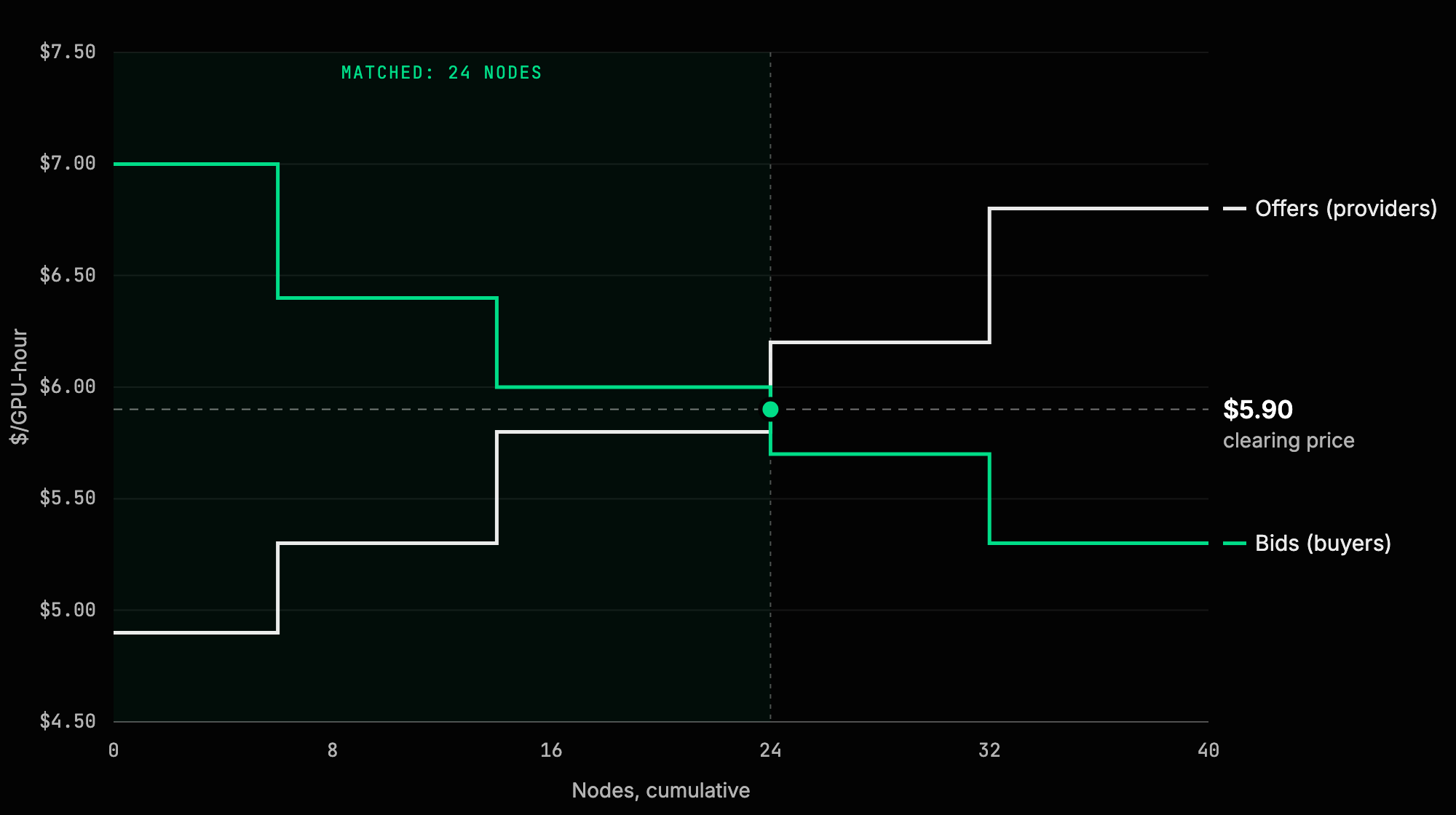
The 24th node clears (Buyer C at $6.00 against Provider 3 at $5.80), but the 25th does not (Buyer D at $5.70 against Provider 4 at $6.20), so 24 nodes trade. Every price from $5.80 to $6.00 matches those 24 nodes with buy and sell volume in balance, so the midpoint rule sets the clearing price at $5.90. Buyer A, who bid $7.00, and Provider 1, who offered $4.90, both trade at $5.90.
Who gets filled
Bids above and offers below the clearing price fill first. If more volume sits exactly at the clearing price than can be matched, those orders fill pro rata in whole nodes, with any leftover nodes going to the earliest orders.
A large bid can be split across several providers. We pair buyers and providers to keep the number of separate contracts as small as possible, and each pairing is its own contract.
What happens after a match
A match forms a binding contract directly between the buyer and the provider, under the standard Compute Services Agreement and SLA. Compute Exchange runs the auction and issues confirmations. It is not a party to the contract, holds no funds in escrow and does not guarantee payment, delivery or uptime.
| When | What happens |
|---|---|
| Within 1 business day of the close | Private confirmation to each side: counterparty, product, nodes, clearing price, TCV, deposit |
| Within 3 business days | Buyer wires a deposit of 20% of TCV directly to the provider |
| April 1, 2027 | Provider delivers bare-metal access; buyer has 3 business days to check the nodes |
| 1st of each month | Provider invoices the buyer monthly in advance, through March 2028 |
| By April 30, 2027 | Provider pays Compute Exchange a 4% platform fee on TCV |
The deposit is an advance on fees, not an extra charge: any unused balance is credited against the last three monthly invoices.
Protections if something goes wrong
The standard terms cover the main ways a contract can go wrong.
No fees are due during a delay and the term is extended to match. If delivery is more than 30 days late, the buyer can cancel for a full refund, including the deposit.
Uptime below 99.5% in a month earns automatic invoice credits, excluding up to 8 hours a month of planned maintenance with 7 days’ notice. A failed node that cannot be fixed within 48 hours must be replaced.
The buyer can terminate without penalty, with unused fees and deposit refunded, if uptime falls below 95% in any month, below 99.5% for three months in a row, or a node is down for more than seven days.
The buyer keeps ownership of all its data, code, models and model weights.
A buyer that does not fund its deposit on time, or a provider that walks away from a match or does not deliver within 30 days of the start date, pays 1% of TCV to Compute Exchange as liquidated damages.
Why one price for everyone
One price the market can see. When each trade settles at its own price, there are as many prices as trades. One clearing price can be published and compared over time. After the auction we may publish anonymized statistics such as the clearing price and total matched volume, without identifying any participant, bid or offer.
Bid what it is worth to you. Because your order mainly decides whether you trade, not the price you pay or receive, there is less reason to shade a bid down or pad an offer up.
Liquidity in one place. A fixed window brings buyers and providers to the same product at the same moment, which one-to-one negotiation cannot.
Confidential by design. Providers can show what they are willing to sell at without revealing it to competitors or existing customers.
Key terms
One bare-metal server with eight GPUs, as defined in the B200 or B300 contract schedule. The smallest unit you can buy or sell.
A bid is a buyer’s order to buy nodes; an offer is a provider’s order to sell them. Each has a quantity and a limit price.
The most a buyer will pay, or the least a provider will accept, in US dollars per GPU-hour, in $0.01 steps.
The single price per GPU-hour at which all matched nodes in a product trade.
No participant sees anyone else’s orders, quantities or identity during the auction.
Clearing price × 8 GPUs × matched nodes × 8,784 hours, the length of the April 2027 to March 2028 term (a leap year).
The private notice each matched party receives after the close, naming the counterparty, nodes, clearing price and TCV.
The whole physical server, rented without a virtualization layer, so the buyer has direct access to the hardware.
Frequently asked questions
Do I need to attend GTC DC to take part?
No. All orders are submitted electronically on app.compute.exchange during the bidding window.
Is this a quote request or a binding trade?
Binding. Every order open at the close is firm, and a match forms a contract between buyer and provider automatically.
Can I buy part of a node?
No. One node of eight GPUs is the smallest unit, and all fills are in whole nodes.
Can a large order be split?
Yes. Orders can be partly filled in whole nodes, and a buyer’s order can be matched across several providers, each a separate contract.
What if no orders cross?
If no bid is at or above any offer, nothing trades for that product.
When will I know where my capacity is?
The U.S. state or metro is disclosed in the transaction confirmation, after matching.
Will results be public?
We may publish anonymized aggregate statistics, such as the clearing price and total matched volume. Individual bids, offers and participants stay confidential.
Governing documents. This post is a summary. Participation is governed by the Auction Participation Agreement and the Auction Documentation (Auction Trading Protocols, B200 and B300 Contract Schedules, and the Compute Services Agreement and SLA), which control if anything here differs.
RELATED ARTICLES
Best GPU Rental Platforms in 2026: A Buyer's Comparison
 Dmytro LokshynJun 12, 2026
The Compute Exchange Is Now SOC 2 Type II Compliant
 Jason CornickJun 5, 2026
NVIDIA H100 GPU Price in 2026: New, Refurbished, and Used
 Carmen LiApr 24, 2026
Reserved GPUs Contract Length: A Complete 2026 Buyer’s Guide
Carmen LiApr 10, 2026Reserved GPUs March 2026
Reserved GPU Marketplaces
Carmen LiMar 4, 2026The Rise of GPU Marketplaces in 2026
Carmen LiFeb 23, 2026H100 vs. H200:Choosing the Right NVIDIA GPU for AI Workloads
Carmen LiFeb 5, 2026[Case Study] How Modular Secures Reserved GPU Capacity
Carmen LiJan 15, 2026Reserved vs. On-Demand GPU in 2026
Carmen Li, CEO at Compute ExchangeJan 5, 2026A100 vs. H100: A 2026 Guide to Choosing the Right NVIDIA GPU
 David KingDec 21, 2025