Refurbished H100 GPUs: When They're the Right Buy

Carmen Li
Table of Content
The discount is narrower than you think
Across 2024 and 2025, refurbished H100s traded in the mid-80% range of new-unit pricing — roughly a 15–20% discount. That is not the discount most infrastructure teams expect when they hear "refurbished." For comparison, used (non-refurbished) H100 units in the same window traded at 60–70% of new pricing, and the gap between the two conditions widens with age: 10–15% at year two, 25–30% by year three.
That pricing signal is worth pausing on. In most hardware categories — enterprise servers, networking gear, consumer electronics — refurbished inventory clears at 30–50% below new. A mid-80% floor on a three-year-old accelerator tells you something structural about the H100 market: demand is strong enough that even second-hand units hold most of their value. CoreWeave's 2022-vintage H100 contracts reportedly rebooked at 95% of original pricing on expiry — a direct proxy for how tightly the market is pricing used Hopper silicon.
So the right question for an infrastructure lead isn't "how much can I save by buying refurbished?" It's "given a 15–20% discount, when is refurbished actually the right procurement tool?" The answer depends on workload profile, timeline pressure, warranty tolerance, and exit plan — not on the sticker price.
What's at stake in the decision
Getting this call wrong costs real money in both directions.
Buy refurbished when you shouldn't, and the savings evaporate against warranty gaps that surface six to eight months in, firmware quirks that cost your platform engineers a week of debug time, and the uncomfortable realization that the original NVIDIA manufacturer warranty explicitly does not transfer to secondary buyers — your coverage is whatever the refurbisher provides, typically 90 days to two years depending on the certification tier.
Skip refurbished when you should have bought, and you forgo 15–20% capex savings on a cluster that can run easily $1.6M–$2M for 64 cards. Worse, you wait 14 weeks for new-unit allocation when refurbished inventory could ship this week — and your model launch was due in six.
The infra outcome that matters is margin protection and launch-timeline protection. Both failure modes compromise it.
How most teams source refurbished H100 capacity today
The current sourcing path for refurbished H100s is a patchwork, and the sourcing time often exceeds the lead-time advantage that refurbished is supposed to provide.
The three common channels:
Direct relationships with IT asset disposition (ITAD) resellers — companies like Alta Technologies that buy decommissioned hyperscaler and enterprise fleets, refurbish, and resell with their own multi-point inspection and warranty. Pricing is opaque. Inventory visibility is limited to whoever happens to pick up the phone.
Hardware broker marketplaces (eBay, Optdex, smaller specialized sites) — thin metadata, inconsistent burn-in reports, warranty terms that vary by listing from 30-day returns to two-year Certified Refurbished.
Secondary offers from neo-cloud providers rotating their fleets — occasionally available when a provider upgrades to H200 or B200 capacity. Pricing tends to be reasonable but inventory is lumpy and buyer relationships take time to build.
Compute Exchange aggregates refurbished H100 inventory across the provider pool into a single view, which is what makes the decision framework below worth running at all — the channel friction is the main reason most infrastructure leads never evaluate refurbished seriously.
See also: the secondary market for H100 hardware for how resale listings are structured.
A decision framework for refurbished H100 procurement
Before you compare refurbished quotes to new-unit quotes, answer five questions about the workload and the organization. The answers determine whether refurbished is viable for your use case — not whether it's cheap.
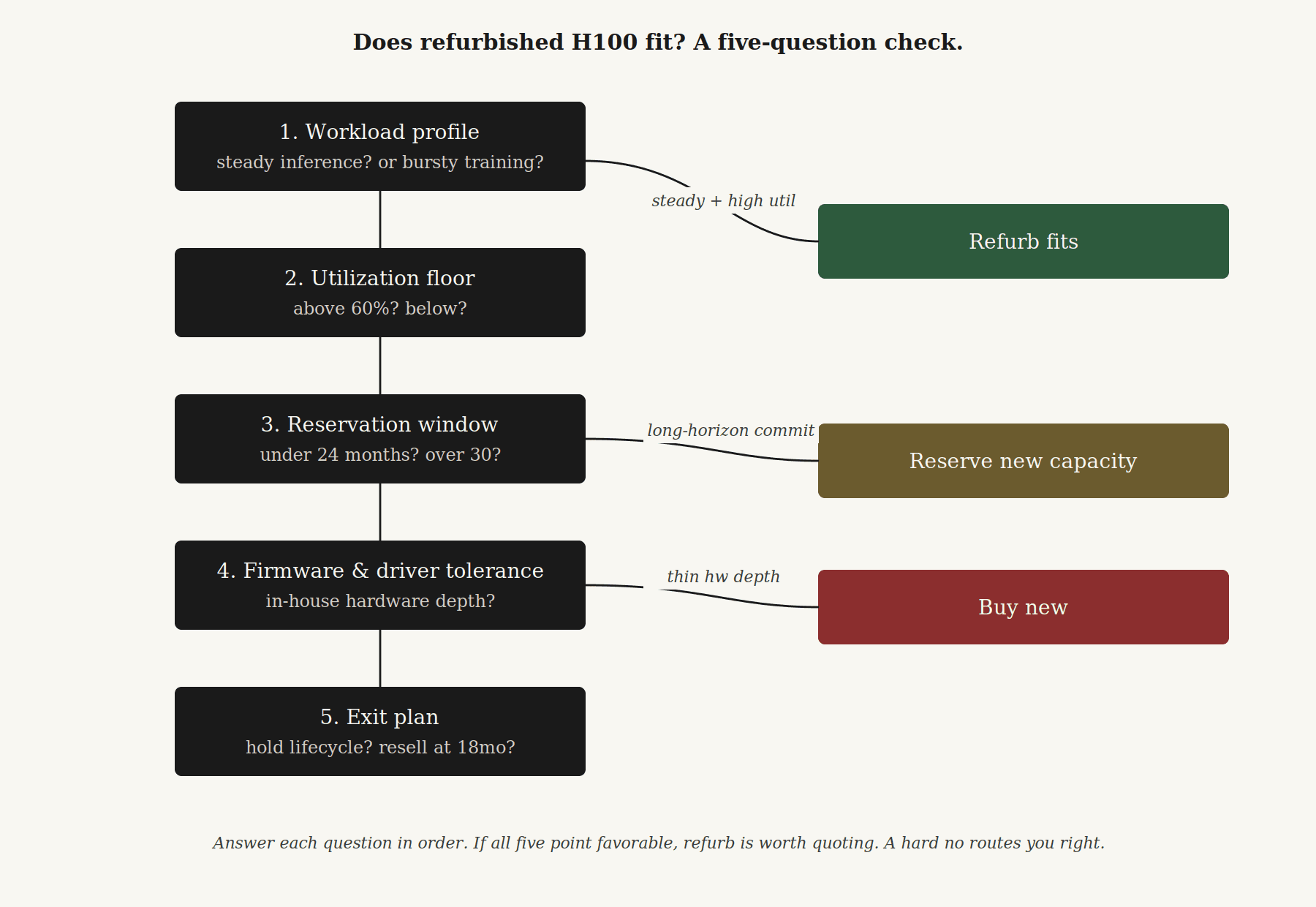
Five questions to run before requesting a refurbished H100 quote. The answers determine fit before price does.
1. Workload profile. Refurbished H100s are a better fit for steady inference workloads than for frontier training. Inference is tolerant of small fleet-level variance — a card that runs 2% slower than its neighbors on a 64-card cluster is fine for serving a model. Training, especially large distributed training, is sensitive to stragglers; fleet variance matters more.
2. Utilization floor. The TCO advantage of refurbished only materializes if you actually run the capacity. Under roughly 60% sustained utilization, renting on-demand wins over any ownership path — new or refurbished. Refurbished is a capex optimization for teams that have already decided to own.
3. Reservation window. Refurbished fits 6–24 month horizons cleanly. Past 30 months, the warranty gap starts to bite and Blackwell-class alternatives pressure the H100's resale value. Reservations beyond that window are usually better served by new units or by leasing structures that include hardware refresh.
4. Firmware and driver tolerance. Refurbished units can carry idiosyncratic firmware versions, remnants of prior deployments, and occasional NVLink topology quirks on SXM cards. If your platform team has in-house hardware engineering depth, this is routine. If they don't, the debug tax can erase the discount.
5. Exit plan. Refurbished H100s hold 75–85% of value for the first ~24 months. If your exit plan is to resell into the aftermarket at month 18, refurbished is a reasonable holding strategy. If your exit plan is to run the cards to end-of-life, you're paying for utility, not resale optionality — and new-unit economics may look closer to parity than the sticker suggests.
If the answers to questions 1, 2, 4, and 5 all come up favorable — steady inference, high utilization, in-house hardware capability, resale-aware exit — refurbished is worth running the full quote on. If any of them is a hard no, the answer is either reserve new capacity (for long-horizon commitments) or buy new outright.
The pricing reality
Below is the H100 price picture as of late 2025 / early 2026, aggregated from public listings and secondary-market research.
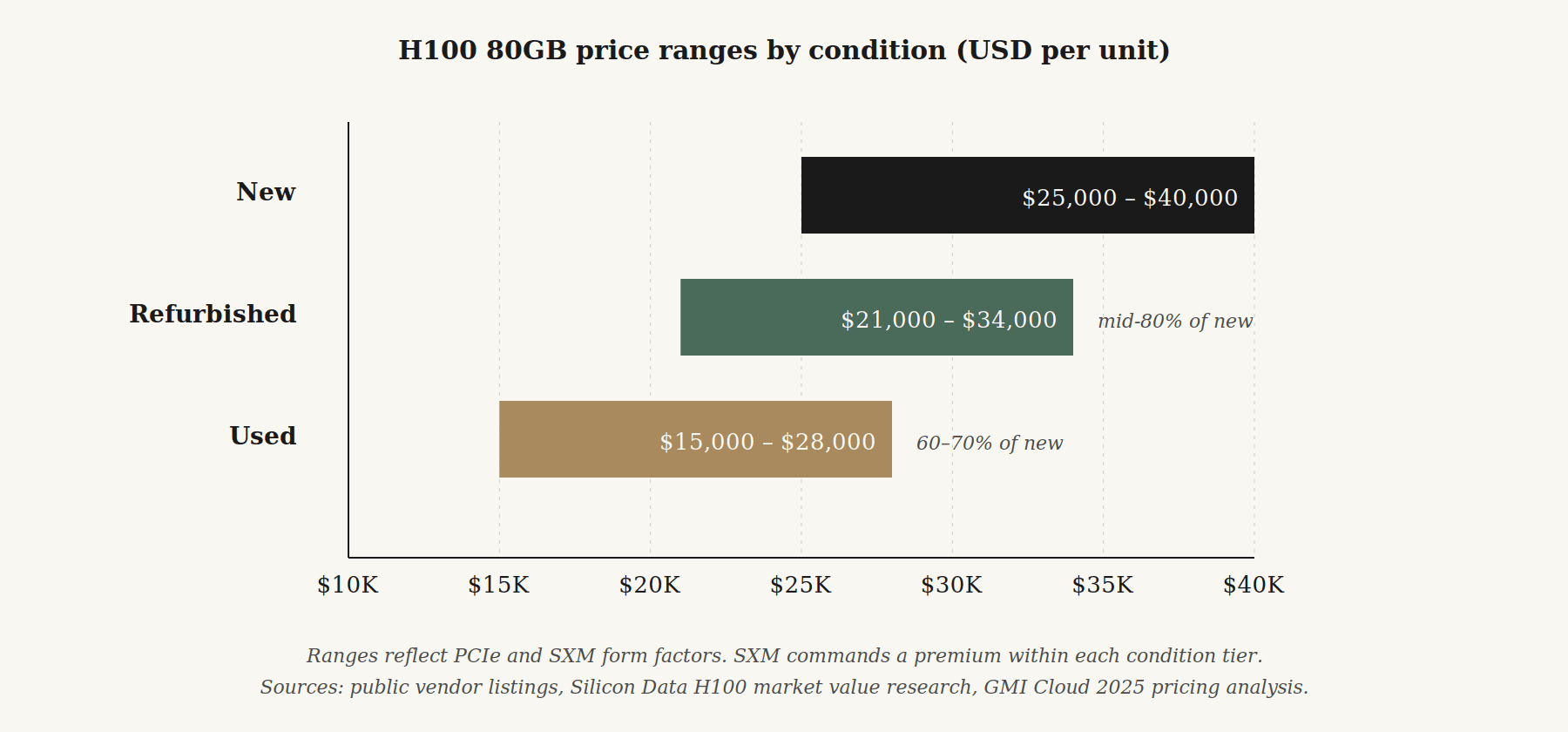
Sources: public vendor listings (Alta Technologies, eBay Certified Refurbished, Optdex), GMI Cloud 2025 pricing analysis, Silicon Data H100 market value research. Ranges are indicative, not TCEX proprietary quotes.
Several dynamics drive where a specific unit lands in the refurbished range:
Age of the unit. Months in service matter more than calendar age. A card pulled from an 18-month hyperscaler deployment with air cooling is a different asset from a card that ran 36 months under liquid cooling in a dense training cluster.
Cooling history. Air-cooled units tend to show less thermal wear than liquid-cooled units that ran at TDP for extended periods, though liquid cooling itself is gentler on silicon when properly maintained.
Provenance. Fleets rotated from Tier-1 hyperscalers typically come with better burn-in documentation and stronger refurbisher warranties than units from opaque aggregators.
Remaining warranty. The single biggest driver of resale variance. A unit with 12+ months of transferable third-party warranty can trade 8–12% above an equivalent unit with expired coverage.
TCO, once you price the risk
The 15–20% sticker discount shrinks when you price in warranty shortfall, expected failure rate, and operational overhead. Here is a representative 64-card cluster comparison over a 24-month reservation window.
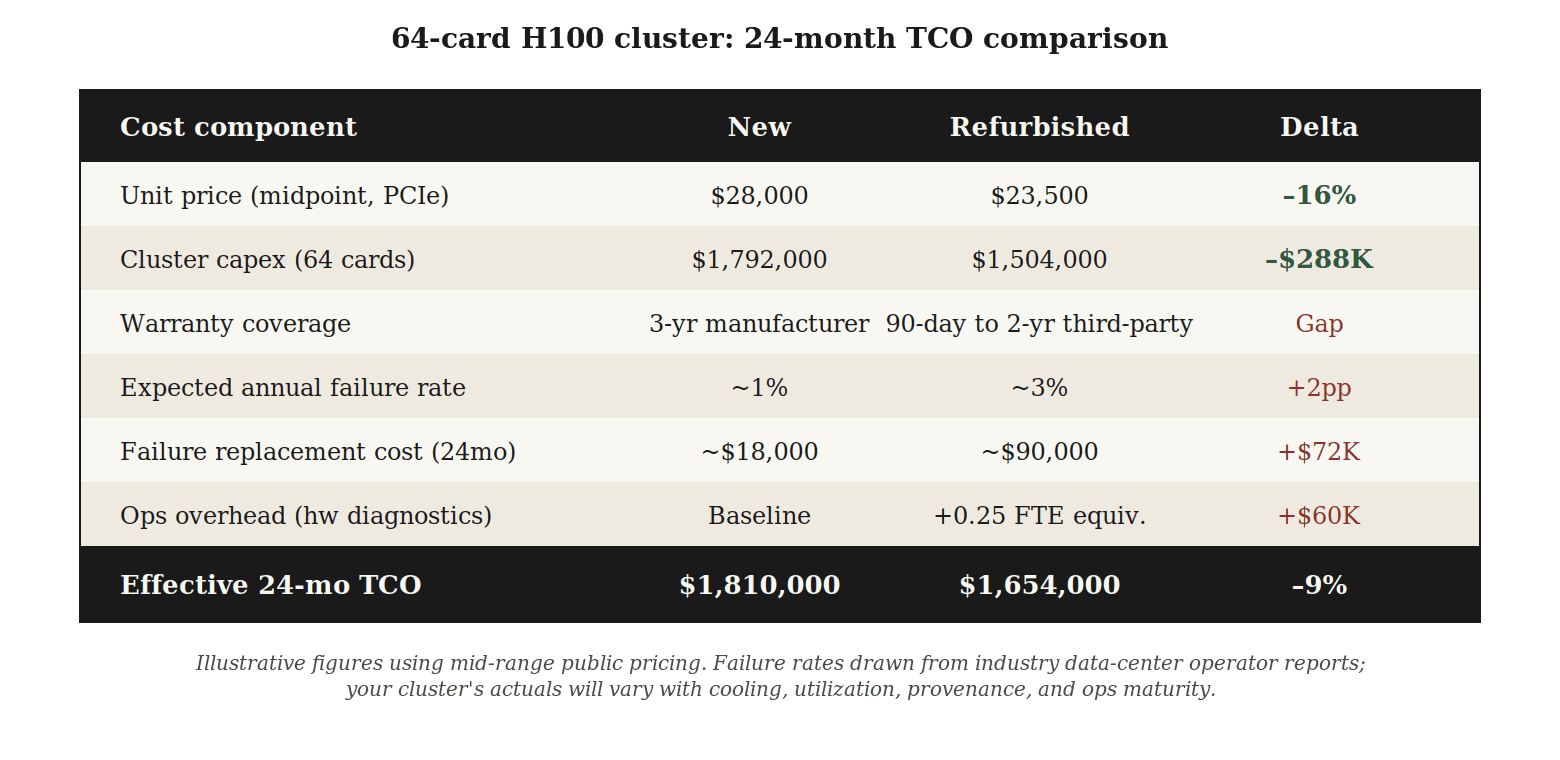
The 16% sticker discount becomes a 9% effective TCO advantage once warranty gap, elevated failure rate, and operational overhead are priced in. Still meaningful — but meaningfully different from the headline number.
A 9% effective TCO advantage on a ~$1.8M cluster is roughly $156K over 24 months. That is real money, and it is the answer to the question "is refurbished worth considering at all?" — yes, for the right conditions. It is also, notably, not the 15–20% the sticker suggested.
The number that deserves the most scrutiny is the failure-rate adjustment. A 3% annual rate on refurbished is a reasonable central estimate but can swing significantly with unit provenance and refurbisher quality. Teams sourcing from rigorous refurbishers with documented burn-in protocols often see rates closer to 1.5–2%; teams buying from broker marketplaces without documentation can see 4–5%. The difference is the warranty and the diligence — which is exactly where a consolidated marketplace view adds value.
Related reading: reserved vs on-demand GPU pricing for when ownership makes sense at all.
The case against refurbished — taken seriously
The strongest argument for buying new is this: for many inference companies running on an 18–24 month capital allocation horizon, without dedicated hardware engineering depth in-house, the warranty and supply-chain clarity of new units is worth the premium. The conditions that make this the right call:
Your workload demands the latest CUDA and driver stack, and you cannot afford firmware variance across the fleet.
Your platform team is already stretched and lacks the hardware diagnostics expertise that refurbished operations require.
Your reservation window extends past 30 months, into the zone where Blackwell-class alternatives will pressure H100 resale value — current forecasts suggest 10–20% downward pressure on H100 secondary pricing when B200 general availability arrives.
You have a path to direct NVIDIA or Tier-1 OEM allocation and the lead times work for your roadmap.
If those conditions hold, new is the correct buy. The honest version of the refurbished argument is not that it is universally cheaper. It is that refurbished is the right procurement tool for a specific set of conditions — steady-state inference, high utilization, in-house hardware capability, 6–24 month horizon — and most infrastructure leads never run the evaluation because sourcing friction makes it impractical. The friction is the reason the check doesn't get run. Remove the friction and the check becomes routine.
Applying the framework
Here is how to run the decision this week.
Step 1 — Profile the workload honestly. Document sustained utilization targets for the next 12–24 months. If you cannot make the 60% floor with conviction, stop here; on-demand or burst capacity is the answer.
Step 2 — Set the reservation window and exit plan. Decide up front whether you are buying to hold full lifecycle or buying with a resale exit at month 18. This changes the math significantly because refurbished H100s hold 75–85% of value through month 24, which means an 18-month resale exit can recover the majority of capex — assuming the cards are maintainable and well-documented.
Step 3 — Run the TCO with warranty and failure-rate adjustments. Do not compare sticker prices. Use the structure from the table above. Stress-test the failure-rate assumption — run the model at 2%, 3%, and 4.5% and see where the refurbished advantage disappears.
Step 4 — Compare on identical reservation terms. Request quotes for the same configuration, same delivery window, same support envelope from both new and refurbished channels. Price them side by side on effective TCO, not sticker. Comparing offers across the provider pool shortens this step from weeks to hours.
The output of the four steps is a defensible procurement decision you can walk your CFO through — with the warranty gap priced, the failure rate sourced, and the exit plan documented. That is the point of the framework. The refurbished-vs-new question stops being a brand preference and becomes a structured capital allocation decision.
The decision, not the discount
The 15–20% discount on refurbished H100s is narrower than the refurbished category usually suggests, which tells you the H100 market itself is structurally tight. That tightness is exactly why the refurbished evaluation is worth running: for steady inference workloads, 6–24 month horizons, in-house hardware capability, and a defined exit plan, refurbished delivers ~9% effective TCO advantage — meaningful, priced for the right risks, and defensible to a CFO.
The work is in the framework, not the discount. The framework is portable across procurement cycles — it will still apply when you're evaluating refurbished H200s eighteen months from now.
Next read: how forward contracts on GPU capacity compare to outright purchase.
How much cheaper is a refurbished H100 than a new one?
Do refurbished H100 GPUs come with a warranty?
How do I verify a refurbished H100 is genuine?
Can refurbished H100s be used for training, or only inference?
What's the resale value of a refurbished H100 after 12 months?
Refurbished H100 GPUs: When They're the Right Buy
Carmen Li
Apr 24, 2026
Reserved GPUs Contract Length: A Complete 2026 Buyer’s Guide
Carmen Li
Apr 10, 2026
Reserved GPUs March 20206
Carmen Li
Mar 26, 2026
Reserved GPU Marketplaces
Carmen Li
Mar 4, 2026
The Rise of GPU Marketplaces in 2026
Carmen Li
Feb 23, 2026
H100 vs. H200:Choosing the Right NVIDIA GPU for AI Workloads
Carmen Li
Feb 5, 2026
[Case Study] How Modular Secures Reserved GPU Capacity
Carmen Li
Jan 15, 2026
Reserved vs. On-Demand GPU in 2026
Carmen Li, CEO at Compute Exchange
Jan 5, 2026
A100 vs. H100: A 2026 Guide to Choosing the Right NVIDIA GPU

David King
Dec 21, 2025